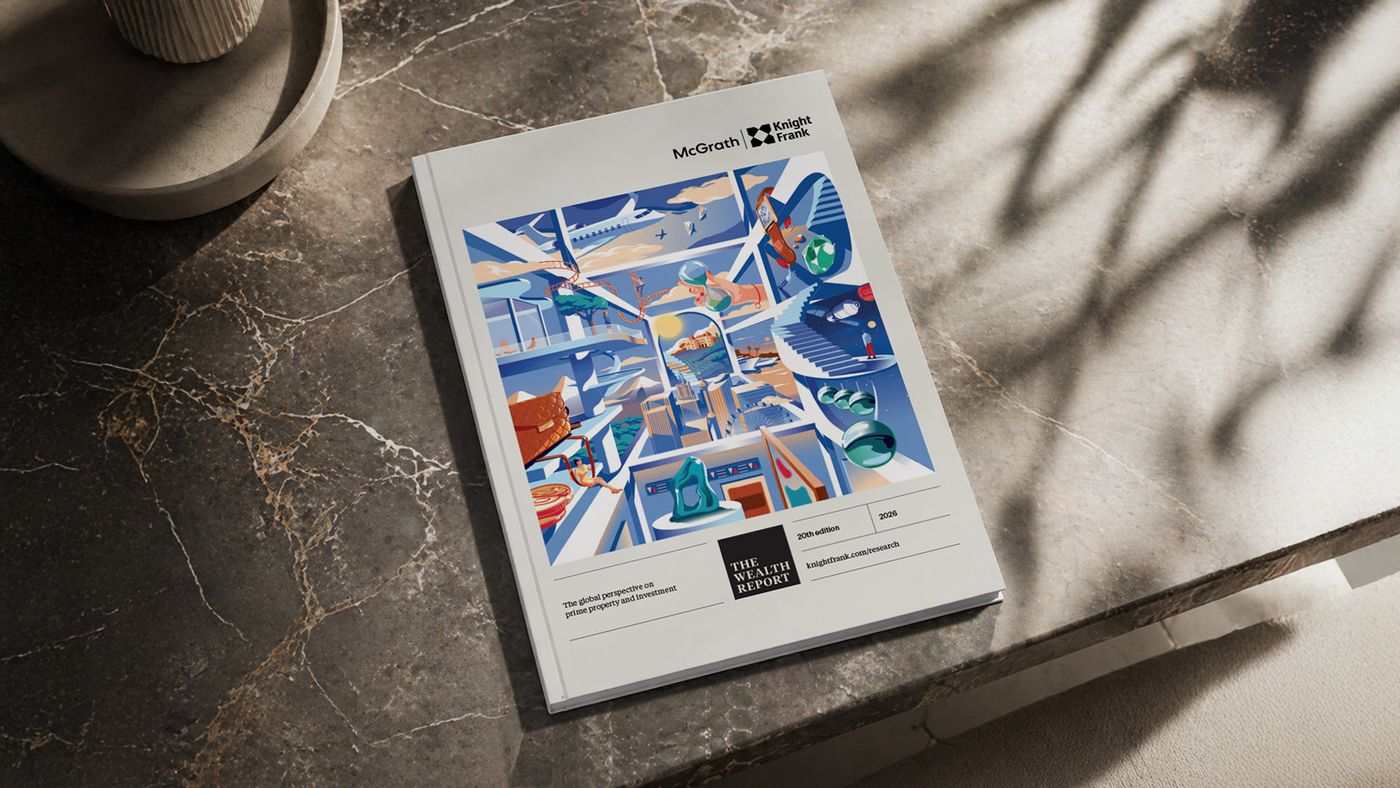
Melbourne bucks the global trend on buying power for luxury property, with US$1m now buying 4% more in the city than 5 years ago: Knight Frank’s The Wealth Report 2026
- US$1m will buy more will buy 4% more luxury residential real estate in Melbourne than 5 years ago, while in Sydney buyers will get 5% less, but both cities remain significantly more affordable than other cities around the globe
- In other Australian cities buying power has also fallen, with Brisbane buying 5% less than 5 years ago for $US1m, while in Perth you will get 11% less space. The Gold Coast has seen the biggest reduction in buying power, at 14%, but still offers the greatest value for money
- Global luxury property prices saw a 3.2% average rise in 2025, with this market outperforming mainstream housing markets for the second consecutive year
- In Australia, Perth (4.1%) recorded growth in luxury residential prices above the global average in 2025, while the Gold Coast (2.8%) and Brisbane (2.1%) saw more modest rises, and Sydney (-0.4%) and Melbourne (-1.3%) saw slight falls.
- Brisbane and the Geelong waterfront have been identified as luxury property hotspots
Australia – Buying power for luxury residential property has been eroded by price growth in many prime locations across the globe over the past 5 years, but in Melbourne you can actually get more bang for your buck, according to Knight Frank’s landmark 20th edition of The Wealth Report, released today.
The report found that US$1m (circa AU$1.5m**) would buy 82.6sq m of luxury residential real estate in Melbourne compared to 79.4sq m five years ago – a 4% increase.
However, Sydney is in line with the global buying power trend - you can buy less luxury real estate for your money than you could five years ago, with US$1 million buying 42.1sq m in 2025, down from 44.2sq m in 2020 – a 5% decrease.
In other Australian cities buying power has also fallen, with Brisbane buying 5% less than five years ago, while in Perth you will get 11% less space for $US1 million. The Gold Coast has seen the biggest reduction in buying power at 14%, but still offers the greatest value for money.
Australian cities still remain significantly more affordable than other cities around the world for luxury residential real estate, with buyers generally getting more bang for their buck.
Luxury real estate price growth outperforms mainstream housing markets
Price growth in luxury residential housing markets globally has contributed to an overall reduction in buying power.
Knight Frank’s The Wealth Report 2026 reports a 3.2% average rise in prime prices over 2025 globally, with this market outperforming mainstream housing markets for the second consecutive year. 73 out of 100 prime markets recorded price growth in 2025, with Tokyo leading globally with a 58.5% surge in prime new-build apartment values.
In Australia, Perth (4.1%) recorded growth in luxury residential prices above the global average, while the Gold Coast (2.8%) and Brisbane (2.1%) saw more modest rises, and Sydney (-0.4%) and Melbourne (-1.3%) saw slight falls.
According to Knight Frank data, Perth is expected to see the greatest growth in prime residential prices over 2026, at 3%, while Brisbane and the Gold Coast are expected to remain stable (0% growth) and Sydney and Melbourne are expected to see a 2% fall. In 2027 Brisbane, the Gold Coast and Perth are expected to be the strongest, with 2% growth in luxury residential prices, while Melbourne will see a 1% rise and Sydney is forecast to be stable.
The global data in Knight Frank’s The Wealth Report 2026 underscores how rapid wealth growth, constrained supply and global investor demand have reduced dollar buying power across many of the world’s top-tier residential markets over time. However in the global context, Australia still offers compelling value.
John McGrath Chief Executive of McGrath Estate Agents, Knight Frank’s partner in Australia* said: “Australia’s luxury residential market is in a strong position and the fundamentals are clear — rising wealth, constrained supply and sustained global interest are all converging. These aren’t competing forces. They’re compounding ones.
“Sydney continues to lead the super-prime market. It recorded the strongest quarter on record for transactions above US$10 million in late 2025 — a result that reflects not just confidence but a structural reappraisal of how global capital views Australian real estate.
“For international buyers, the value proposition remains genuinely compelling. Price per square metre across Sydney, Melbourne and Brisbane compares favourably with London, New York, Singapore and Hong Kong. Australia offers world-class lifestyle credentials while still trading at a meaningful discount to many of its global peers.
“Melbourne presents its own opportunity. A modest softening in prices over the past five years has improved buying power at the top end, making it one of the more attractive entry points into a global-tier city at this moment.
“Looking ahead, the demand dynamics only strengthen. Knight Frank’s data projects Australia’s ultra-high-net-worth population will grow by nearly 60 per cent over the next five years, with the billionaire cohort rising by 77 per cent. That represents a significantly deepening pool of buyers — in a market where prime stock is already in short supply.”
Liam Bailey, Knight Frank’s Global Head of Research and editor of The Wealth Report comments: “In many markets, prime residential property has pulled away from the broader housing sector, underpinned by the strength of wealth creation. While mainstream markets remain exposed to wider economic pressures, the pace at which wealth is being generated is helping to keep demand for luxury property more resilient, even against recent volatility in debt costs.”
Brisbane singled out as one of the world’s emerging global luxury hotspots
Brisbane has been singled out as one of the world’s emerging global luxury hotspots alongside Miami, Mumbai and Abu Dhabi in Knight Frank’s The Wealth Report 2026.
The report found Queensland’s capital city was one of just a few cities experiencing unprecedented change in its luxury appeal, and reshaping the geography of prime real estate. Brisbane - Australia’s third largest city - is experiencing rapid growth propelled by the 2032 Olympic Games and significant government infrastructure investment.
A favourable planning environment has allowed developers to fast-track luxury projects, pushing top-end apartment prices from a historical ceiling of around US$6 million (circa AU$9 million) to more than US$10 million (circa AU$15 million) in just 12 months. Super-prime product in Brisbane is now exceeding US$32,000 (circa AU$48,000) per square metre, reflecting intense demand for high-quality, turnkey apartment stock.
The report also highlights strong momentum across Queensland’s broader luxury market, with lifestyle-led destinations such as the Gold Coast continuing to attract affluent buyers seeking prime homes and second residences. In Queensland, sales above US$15 million (AU$22.5 million) are becoming increasingly common - a level that would once have been considered exceptional.
Geelong named one of the world’s hottest housing markets
The Geelong waterfront, on the north facing shores of Corio Bay, has been identified as one of the world’s hottest luxury housing markets in Knight Frank’s The Wealth Report 2026.
The precinct, situated in regional Victoria around 75 kilometres southwest of Melbourne, was named as a neighbourhood set to outperform alongside other markets around the globe including Dalefield in New Zealand’s Queenstown, Lake Como in Italy and the Pacific Palisades in Los Angeles.
The pick highlights the region’s growing appeal to high-net-worth buyers and investors seeking lifestyle-led, waterfront locations beyond the capital cities.
The report recognises the Geelong waterfront’s unique combination of coastal amenity, proximity to Melbourne and strong infrastructure investment, positioning it as one of Australia’s standout regional markets attracting increasing interest from domestic and international purchasers.

Contact
Terri Sissian
April 23, 2026
6 min read
Share this Media Release